Walking a cat outdoors is no longer a quirky novelty reserved for eccentric pet owners. In 2024, more cat parents than ever are discovering that structured outdoor time—facilitated by a high-quality cat harness and leash—delivers profound mental and physical benefits that indoor life simply cannot replicate. As urban living spaces shrink and feline obesity rates rise, the “adventure cat” movement has pivoted from a social media trend into a recognized standard for feline enrichment. Providing a cat with the opportunity to engage its primal senses—smelling fresh grass, hearing the rustle of leaves, and watching insects—can significantly reduce behavioral issues like over-grooming, nocturnal zoomies, and territorial aggression. However, the transition from the living room to the garden requires more than just a leash; it requires a specialized understanding of feline biomechanics and safety gear designed specifically for their unique frames.
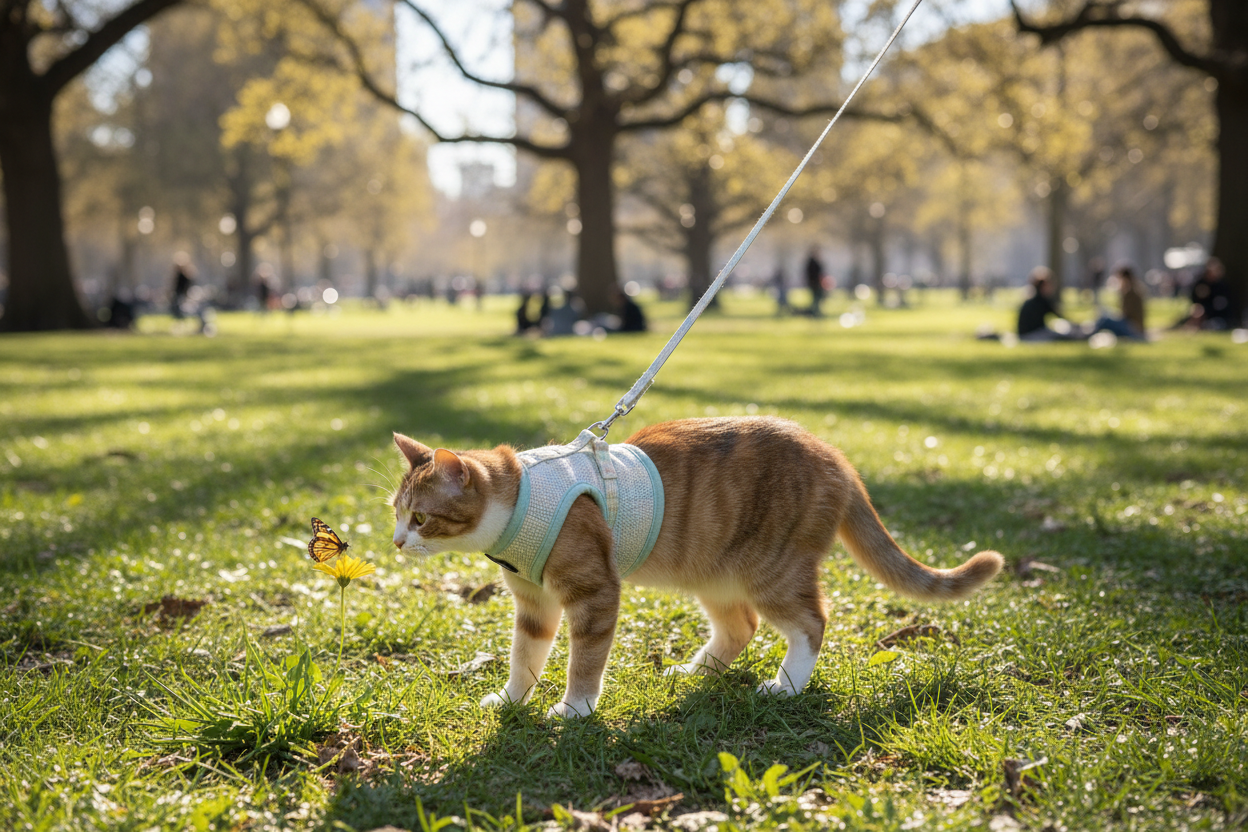
A landmark peer-reviewed study published in PMC (NCBI), which surveyed participants across seven different countries, found that cat owners consistently reported a marked increase in enrichment and a decrease in stress-related behaviors after implementing regular leash walking. The data also confirmed that over 26% of U.S. households now own at least one cat, and a growing segment of this population is actively seeking safe ways to transition their pets into supervised outdoor environments. Despite the enthusiasm, many owners face a steep learning curve. The primary obstacle is that a poorly chosen harness can turn a potentially life-enhancing experience into a frustrating, or even lethal, situation. Cats are built differently than dogs; their narrower chests, highly flexible spines, and a visceral instinct to “reverse” out of perceived traps make standard pet gear unsuitable.
The Critical Flaw of the Standard Collar
It is a fundamental rule among feline behaviorists: a collar alone is never appropriate for walking a cat. While collars are excellent for holding ID tags, they are dangerous for tethering. Under even minor stress, a cat can compress its chest and slip backward out of a collar in seconds. This risk becomes terrifyingly real the moment a cat is startled by a passing car or a barking dog. Furthermore, a cat’s trachea is incredibly delicate. A well-fitted harness is designed to distribute pressure across the chest and shoulders rather than concentrating it on the neck, effectively protecting the throat from strain while making an escape significantly harder.
Understanding Feline Biomechanics
Cat bodies differ from dog bodies in several key ways that make dog-specific harnesses a poor fit. Most notably, cats possess a narrower sternum and more pronounced shoulder blades that allow for a greater range of lateral spinal movement. Harnesses designed for small dogs often sit incorrectly on a cat’s frame, creating painful pressure points or, conversely, leaving large gaps near the armpits that create easy escape routes. A purpose-built cat harness accounts for these proportions, ensuring that the gear moves with the cat rather than against it. High-end models in 2024 are now utilizing 3D-mapping technology to create ergonomic shapes that mimic the natural contours of the feline musculoskeletal system.
The Gold Standard: Escape-Proof Design
The most important safety requirement for any feline gear is that it must be escape-proof. When a cat is in a state of high arousal or fear, its first instinct is to reverse direction and pull free. A harness that relies on a single adjustable loop around the chest offers almost no resistance to this maneuver. The industry-leading designs today utilize figure-H or vest styles. These wrap around both the neck and the chest with two separate points of contact. This dual-point system makes it nearly impossible for a cat to back out without unfastening a buckle, as the neck loop acts as an anchor against the chest strap.
Exploring the Three Main Harness Styles
- Vest-Style Harnesses: Generally recommended for beginners, these provide a broad contact area that can have a calming effect similar to a “Thundershirt.” They offer the least opportunity for a cat to wriggle free but can be warm in summer months.
- Figure-H Harnesses: Consisting of two loops connected by a strap, these are lightweight and offer maximum freedom of movement. They are ideal for experienced adventure cats who find vests too restrictive.
- Step-In Harnesses: These are designed for cats that dislike things being slipped over their heads. While convenient, they must be fitted perfectly, as they can sometimes be easier to slip out of if the girth is not snug.
The Two-Finger Rule and Perfect Sizing
No feature matters more than the fit. A harness that is too loose defeats its purpose, while one that is too tight restricts breathing. Experts recommend the two-finger rule: you should be able to slide exactly two fingers under any strap of the harness when it is fastened. If you can fit three fingers, it is too loose; if only one fits, it is too tight. To get the right size, you must measure two dimensions: the Neck Girth (around the base of the neck) and the Chest Girth (the widest part behind the front legs). If your cat falls between sizes, it is usually safer to opt for the larger size and adjust the straps down to ensure full coverage.
Advanced Material Science in 2024
The material of the harness directly impacts a cat’s willingness to wear it. Heavy nylon webbing, common in dog products, can be stiff and abrasive on a cat’s fine coat. Look for breathable air-mesh, which allows for ventilation, or soft neoprene, which prevents chafing. In 2024, many brands are also introducing reflective stitching and antibacterial linings to keep the cat visible and clean after trekking through damp grass.
The Leash: More Than Just a String
The leash is the second half of the safety system. For cats, a 4 to 6-foot standard leash is the professional recommendation. It provides enough slack for sniffing while ensuring the owner maintains immediate control. Retractable leashes are generally discouraged; the constant tension can be confusing for a cat, and the thin cords are prone to snapping or causing friction burns if a cat bolts. Furthermore, always utilize a back-clip attachment. A D-ring located between the shoulder blades keeps the leash away from the cat’s face and prevents tangling in their legs.
Expert Review: The Rise of the “Tactical” Cat Vest
Recent expert reviews highlight a shift toward “tactical” style vests for cats. These often include MOLLE systems for small ID pouches and heavy-duty Velcro. While they look rugged, experts warn that the added weight can sometimes discourage smaller cats from moving naturally. The consensus among veterinary behaviorists is to prioritize weight-to-strength ratios. A harness should be strong enough to withstand a 20lb lunge but light enough that the cat forgets they are wearing it within five minutes of the walk beginning.
Frequently Asked Questions (FAQ)
1. At what age can I start walking my cat?
You can begin harness training as early as 8 to 12 weeks old. Kittens are generally more adaptable and will accept the sensation of the harness more readily than older cats.
2. How long does it take to leash train a cat?
It varies. Some cats take to it in a week, while others may take months of indoor practice. Always let the cat set the pace.
3. My cat just flops over when I put the harness on. What do I do?
This is a common reflex called “the flop.” It is a natural response to the sensation of pressure on their back. Use high-value treats and play to encourage them to stand up and move.
4. Can I take my cat to a dog park?
Absolutely not. Dog parks are unpredictable and dangerous for cats. Stick to quiet, low-traffic areas like your backyard or a secluded corner of a park.
5. Is a harness safe for a senior cat with arthritis?
Yes, but choose a soft, padded vest that doesn’t require them to lift their legs to put it on. Short, sensory-focused walks can actually help keep their joints mobile.
Conclusion
Investing in a high-quality cat harness and leash is an investment in your cat’s longevity and happiness. By choosing a design that respects feline anatomy and focusing on an escape-proof fit, you open up a world of enrichment that bridges the gap between the safety of the indoors and the stimulation of the wild. According to the Journal of the American Veterinary Medical Association, the average lifespan of a fully outdoor cat is only 4.5 years, compared to 15 years for indoor cats. Leash walking provides the perfect middle ground—allowing your cat to experience the world without the terminal risks of roaming free. Start slow, prioritize safety, and soon you and your cat will be enjoying the great outdoors together.


