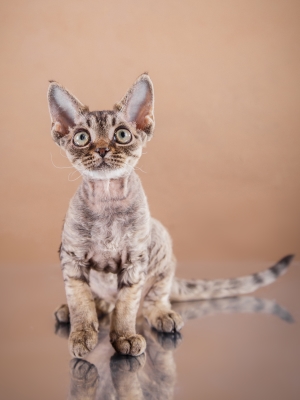
With their oversized ears, high cheekbones, and large, soulful eyes, the Devon Rex is often described as the ‘pixie’ or ‘alien’ of the feline kingdom. This unique breed, originating from the rugged landscape of Devonshire, England, in the late 1950s, has captivated cat enthusiasts for decades. Unlike many breeds that boast thick, flowing manes, the Devon Rex is celebrated for its short, curly coat that feels like crushed velvet under the hand. But beyond their striking, elfin appearance lies a personality that is even more remarkable. Often referred to as ‘monkeys in cat suits,’ Devon Rexes are high-energy, incredibly social, and deeply loyal companions that refuse to be ignored. Whether they are perched on your shoulder or curled up in the crook of your neck, these cats define what it means to be a ‘people-oriented’ pet. As we move into 2024, the popularity of this breed continues to soar among apartment dwellers and families alike due to their adaptable nature and minimal shedding.
The History and Origin of the Devonshire Pixie
The story of the Devon Rex began quite by accident in 1960. A feral cat with a strange, curly coat was spotted near an abandoned tin mine in Devon, England. This cat eventually sired a kitten named Kirlee, who possessed the same unique waves. Initially, breeders believed Kirlee was related to the Cornish Rex, a breed discovered a decade earlier. However, test matings proved that the genetic mutation responsible for the Devon’s coat was entirely distinct. While the Cornish Rex lacks guard hairs and has a more uniform wave, the Devon Rex possesses a coat that is ‘whirled’ or ‘curled’ rather than simply wavy. This distinction solidified the Devon Rex as a breed of its own, eventually gaining worldwide recognition for its singular look and delightful temperament.
Physical Characteristics: The Elfin Aesthetic
The Devon Rex is a small-to-medium-sized cat, typically weighing between 6 and 9 pounds. Despite their delicate appearance, they are surprisingly muscular and heavy for their size. Their most defining feature is the head shape: a short wedge with prominent cheekbones and well-defined whisker pads. Their ears are exceptionally large, set low on the head, and often tipped with tufts of fur known as ‘ear muffs.’ These features, combined with their short noses and wide-set eyes, give them an expression of perpetual curiosity.
Their coat is their crowning glory. Unlike most cats, the Devon Rex has a very short coat that lacks the standard guard hairs found in other breeds. The result is a texture similar to fine silk or crushed velvet. Because their fur is so sparse, they are much warmer to the touch than other cats, making them the ultimate ‘lap heaters.’ This lack of heavy insulation means they actively seek out warm spots, from sun-drenched windowsills to the top of your computer monitor. If you are considering adding one to your home, it is vital to learn how to choose the right litter for your cat to ensure their sensitive paws and respiratory systems remain healthy in their indoor environment.
Personality Traits: The Social Butterfly
If you are looking for a quiet, independent cat that keeps to itself, the Devon Rex is likely not the breed for you. These cats thrive on human interaction. They are famous for following their owners from room to room, supervising household chores, and ‘talking’ in a quiet, chirpy voice. Their intelligence is off the charts; many Devon Rex owners report that their cats can learn tricks, play fetch, and even open cabinet doors. They are highly active and love to climb, meaning vertical space like cat trees and wall shelves are essential for their well-being.
Interestingly, while they are active, they are exceptionally well-suited to apartment life. Their compact size and preference for indoor warmth make them ideal urban companions. They are generally friendly with other pets, including dogs, provided they are introduced properly. In fact, many households find that a Devon Rex provides a fascinating contrast to larger, more stoic breeds. For example, comparing the petite Devon to the robust nature of a Maine Coon highlights just how diverse the feline world can be in terms of energy and physical needs.
Grooming and Skin Care: Less is More
One of the biggest misconceptions about the Devon Rex is that they are hypoallergenic. While no cat is truly hypoallergenic, the Devon Rex does shed significantly less than other breeds, which may make them more tolerable for some allergy sufferers. However, their unique coat requires a specific type of care. Because they lack guard hairs to absorb skin oils, their skin can become greasy or ‘grubby’ if left unmanaged. Unlike long-haired breeds that require daily brushing, the Devon Rex needs minimal brushing; in fact, over-brushing can actually damage their fragile fur.
Occasional cleaning is necessary to manage oil buildup. Learning how to give your cat a bath safely is a valuable skill for a Devon owner, as a gentle soak every few weeks can keep their skin healthy and their ‘crushed velvet’ coat feeling fresh. Always use a veterinarian-approved, mild shampoo to avoid irritating their sensitive skin.
Health and Longevity: What Owners Should Know
The Devon Rex is generally a hardy breed with a lifespan of 10 to 15 years, but like all purebred cats, they are predisposed to certain genetic conditions. According to veterinary data through 2024, potential owners should be aware of:
- Hypertrophic Cardiomyopathy (HCM): The most common form of heart disease in cats, which causes thickening of the heart walls.
- Patellar Luxation: A condition where the kneecap slips out of place, common in smaller, active breeds.
- Congenital Myasthenic Syndrome (CMS): Also known as Devon Rex Myopathy, this is a muscle-weakening condition that usually manifests between 3 weeks and 6 months of age.
- Hereditary Baldness: Some Devons may experience thinning fur or bald patches as they age due to their specific hair-growth genes.
Regular veterinary check-ups and genetic screening from reputable breeders are the best ways to ensure a long, healthy life for your Devon. Because they are prone to dental issues, a diet of high-quality food and regular teeth cleanings are also recommended.
Expert Verdict: Is the Devon Rex Right for You?
The Devon Rex is a masterpiece of nature and selective breeding. Expert feline behaviorists often rank them as one of the most ‘dog-like’ cat breeds because of their loyalty and trainability. However, they demand a significant amount of attention. If you work long hours away from home, you might consider getting a second cat to keep your Devon company, as they can suffer from separation anxiety. For the active family or the dedicated home-body, the Devon Rex offers a level of companionship that few other breeds can match. They are not just pets; they are mischievous, loving members of the family who will keep you entertained with their antics for years to come.
Frequently Asked Questions (FAQ)
Are Devon Rex cats hypoallergenic?
No cat is 100% hypoallergenic. While the Devon Rex sheds very little and produces less dander than many other breeds, they still produce the Fel d 1 protein in their saliva and skin oils, which is the primary cause of cat allergies.
Do Devon Rex cats get cold easily?
Yes. Because of their very thin, short coats, they lack the insulation of most other breeds. They are notorious ‘heat seekers’ and will often be found near heaters, under blankets, or on your lap.
How much do Devon Rex cats usually cost?
As of 2024, a Devon Rex kitten from a reputable, TICA-registered breeder typically costs between $1,000 and $2,500, depending on lineage, coat color, and location.
Can Devon Rex cats be left alone?
They generally do not do well when left alone for long periods. They are highly social and require significant mental and physical stimulation. If you are away often, having another pet for company is highly recommended.
What is the difference between a Devon Rex and a Cornish Rex?
While both have curly coats, the Devon Rex has a shorter muzzle, larger ears set lower on the head, and a different genetic mutation. The Devon’s coat is more of a ‘swirl’ compared to the tight, uniform ‘marcel wave’ of the Cornish Rex.
Conclusion
In the world of domestic felines, the Devon Rex stands out as a truly exceptional companion. Their ‘elfin’ charm, combined with an intellectual curiosity and a heart of gold, makes them one of the most rewarding breeds to own. While they require a bit of extra care in terms of warmth and skin management, the love and laughter they bring into a home are well worth the effort. If you are ready for a cat that will be your constant shadow and your most playful friend, the Devon Rex is waiting to enchant you.


