When you think of majestic, long-haired felines that command presence in a room, the Maine Coon or the Persian often comes to mind. However, nestled in the snowy history of Scandinavia is a breed of equal—if not superior—grandeur: the Norwegian Forest Cat. Known affectionately as the ‘Wegie,’ this breed is far more than just a fluffier version of your average house cat. They are living legends, biological marvels designed to survive sub-zero temperatures, and incredibly intelligent companions that offer a unique blend of independent spirit and canine-like loyalty. Whether they are scaling the heights of your bookshelves or lounging by a sunlit window, the Norwegian Forest Cat brings an aura of the ancient North into modern homes.
The Mythical Origins of the ‘Skogkatt’
To understand the Norwegian Forest Cat, one must look back at the folklore of Norway. Known locally as the Skogkatt (literally ‘forest cat’), these felines were more than just pest controllers on Viking ships; they were the stuff of legend. Norse mythology suggests that Freya, the goddess of love, beauty, and fertility, traveled in a chariot pulled by two massive, long-haired cats. While we cannot scientifically prove goddess-led transportation, it highlights the deep-rooted cultural significance of the breed. These cats likely evolved from short-haired cats brought to Norway by the Vikings around 1000 A.D., crossbreeding over centuries with local feral populations to adapt to the harsh climate.
By the 20th century, the breed faced a crisis. Post-World War II crossbreeding almost caused the purebred Skogkatt to disappear forever. It was only through the dedicated efforts of Norwegian cat fanciers in the 1970s that a formal breeding program was established to preserve their genetic heritage. This revival was so successful that King Olaf V eventually designated the Norwegian Forest Cat as the official cat of Norway. They made their official debut in the United States in 1979, quickly capturing the hearts of cat lovers who were already fans of larger breeds. If you are comparing this breed to other large felines, you might find our cat breed guide: Maine Coon helpful for distinguishing between these two forest-dwelling giants.
Physical Characteristics: Built for the Arctic
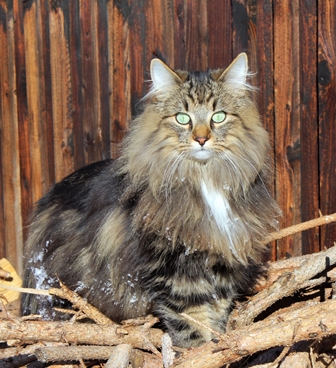
The Wegie is a sturdy, muscular cat designed for survival. One of their most striking features is their waterproof double coat. This consists of a dense, woolly undercoat for warmth and a long, glossy, water-resistant overcoat. During the winter, they develop a magnificent ‘ruff’ around their neck and ‘britches’ on their hind legs, giving them a lion-like appearance. Interestingly, despite their heavy winter look, they shed a significant portion of this undercoat in the spring, appearing much sleeker during the summer months.
Size-wise, they are impressive. Adult males typically weigh between 12 and 20 pounds, while females range from 8 to 18 pounds. Unlike most domestic cats that reach full size by age one, the Norwegian Forest Cat is a slow-growing breed, often not reaching full physical maturity until they are five years old. Their ears are tufted, much like a lynx, and their paws are heavily feathered with fur to protect them from walking on ice and snow. Because of their thick fur, owners often wonder about hygiene; while they are self-sufficient, knowing how to give your cat a bath can be useful if they happen to get into something messy, though their coat naturally repels most dirt.
Temperament and Social Behavior
The personality of a Norwegian Forest Cat is often described as ‘equanimous.’ They are rarely high-strung. Instead, they possess a quiet confidence. They are incredibly social with their ‘chosen’ humans but aren’t necessarily ‘velcro cats’ that will follow you from room to room demanding constant attention. They prefer to be in the same room as you, perhaps perched on a high shelf observing your activities. They are famous for their climbing abilities; their strong claws allow them to descend trees (or cat towers) head-first, a feat most other breeds cannot accomplish.
Wegies are generally excellent with children and other pets, including dogs. Their laid-back nature makes them highly adaptable to busy households. However, they do require mental stimulation. Because of their history as hunters, they enjoy puzzle toys and interactive play sessions that mimic the hunt. If you are integrating one into a multi-pet home, providing a clean and private environment for their needs is vital; choosing the right litter and box placement can help these large cats feel secure in their territory.
Health and Longevity
While the Norwegian Forest Cat is a naturally evolved breed and generally very healthy, they are predisposed to a few genetic conditions. The most notable is Glycogen Storage Disease IV (GSD IV), a rare metabolic disorder. Most reputable breeders now test for this to ensure it isn’t passed down. They can also be prone to Hypertrophic Cardiomyopathy (HCM), a common form of heart disease in cats, and hip dysplasia due to their large size.
On average, a healthy Wegie lives between 14 and 16 years. To maximize their lifespan, regular veterinary checkups are non-negotiable. Obesity can be a significant risk for this breed because their thick fur can hide extra weight. Owners should feel for the ribs regularly and consult with a vet about appropriate caloric intake, especially as the cat transitions from the high-energy kitten phase to a more sedentary adult lifestyle.
Dietary Needs and Grooming Essentials
As obligate carnivores, Norwegian Forest Cats require a diet rich in animal protein. Because they are a large breed, they benefit from food that supports joint health, such as those containing Omega-3 fatty acids. High-quality wet food is often recommended to ensure they stay hydrated, as some Wegies can be prone to kidney issues later in life.
Grooming, surprisingly, is not as intensive as one might think. While a Persian requires daily brushing, a Wegie’s coat is relatively tangle-resistant. A thorough weekly brushing is usually sufficient to remove loose hair and prevent matting. During the spring ‘molt,’ you may need to increase this to daily sessions to keep the hair off your furniture and prevent hairballs. Their claws grow quickly and are quite strong, so regular trimming and providing tall, sturdy scratching posts are essential to protect your home decor.
Expert Verdict: Is the Norwegian Forest Cat Right for You?
The Norwegian Forest Cat is an ideal choice for a family looking for a ‘dog-like’ cat that is sturdy, intelligent, and affectionate without being overly demanding. They are best suited for indoor living where they can be protected from the elements and local wildlife, but they do require vertical space to satisfy their climbing instincts. If you appreciate a pet with a bit of mystery, a lot of fur, and a gentle heart, the Wegie is an unparalleled companion.
Frequently Asked Questions (FAQ)
- Are Norwegian Forest Cats hypoallergenic? No, they are not. They produce Fel d 1 protein and shed dander like most breeds. However, their lower shedding frequency outside of spring may be easier for some mild allergy sufferers.
- How can I tell the difference between a Wegie and a Maine Coon? Look at the face. The Norwegian Forest Cat has a straight profile (from brow to nose tip) and a triangular head shape, whereas the Maine Coon has a ‘stop’ or break in the profile and a more square muzzle.
- Do they like water? Many do! Thanks to their water-resistant coats, they often find dripping faucets or even shallow baths fascinating rather than frightening.
- How much does a Norwegian Forest Cat cost? From a reputable breeder, expect to pay between $800 and $1,500, depending on the lineage and location.
- Are they loud? No, Wegies are relatively quiet. They tend to use ‘chirps’ and ‘trills’ rather than loud, persistent meowing.
Conclusion
The Norwegian Forest Cat is a testament to nature’s ability to create beauty through necessity. From the frozen forests of Norway to the comfort of a modern living room, these cats have retained their dignity, intelligence, and rugged charm. By understanding their unique history and specific health needs, you can provide a home where this ‘official cat of Norway’ can truly thrive. With the right care, a Wegie will not just be a pet, but a majestic, purring piece of history that stays by your side for nearly two decades.


